


Table of Contents
ToggleFitness and wellness apps have transformed how people practice yoga and maintain healthy lifestyles. While some fitness giants focus on generic workout solutions, specialized apps like Yoga Go are addressing specific niches by offering AI-powered yoga instruction with real-time pose correction and personalized guidance.
As the wellness industry continues to grow in 2025, more entrepreneurs are interested in developing apps like Yoga Go to capitalize on the expanding market. Their goal? Creating intelligent yoga platforms that combine artificial intelligence with traditional wellness practices while generating sustainable revenue.
However, when we talk about developing a Yoga Go clone app, a question strikes every time, i.e., how much does it cost to develop an app like Yoga Go? It is crucial for entrepreneurs to understand the cost and investment involved in AI-powered yoga app development.
So, in this blog, we have provided the estimated costs to develop an app like Yoga Go along with the factors that influence the costs to make you understand better. Also, we have provided a development process and monetization strategies for your yoga app.
By the end of this guide, you’ll have a clear roadmap to confidently begin building your own Yoga Go-like wellness app in 2025.
Latest Market Statistics for Fitness Apps and Yoga Go
- The global fitness app market was valued at $10.59 billion in 2024 and is expected to reach $12.12 billion in 2025, growing at a CAGR of 13.9%.
- The international yoga market was estimated at $107.1 billion in 2023, expected to grow at 9.4% CAGR through 2030.
- Fitness apps generated $3.98 billion in revenue in 2024, an 11.1% increase over the prior year.
- Over 74% of Americans use at least one fitness app, creating intense competition but also demonstrating market demand.
How Much Does it Cost to Develop an App like Yoga Go?
Yoga Go is a sophisticated AI-powered yoga application with real-time pose detection and personalized instruction capabilities.
| Type of App | Estimated Development Costs |
|---|---|
| Basic | $20,000 to $40,000+ |
| Advanced | $35,000 to $60,000+ |
| Complex | $60,000 to $80,000+ |
Please note that the development costs given above are only estimations. Actual costs may differ based on AI complexity, content requirements, and platform specifications.

Top Factors That Drive the Cost of Building a Yoga Go-like App
The following are the top factors that affect the development costs for an app similar to Yoga Go.
1. App's Features and Functionalities
The major factors that influence Yoga Go clone app development costs are the number and type of features and functionalities you integrate. When you develop an app with basic yoga video playback, it will cost you less.
Similarly, adding advanced features like AI pose detection, real-time feedback, personalized workout plans, and progress tracking significantly increases the cost of development. The cost increases further when you build a complex app like Yoga Go with machine learning algorithms and computer vision capabilities.
2. AI Integration and Pose Detection Technology
In AI-powered yoga apps like Yoga Go, accurate pose detection and real-time feedback require sophisticated artificial intelligence and computer vision algorithms.
Hence, when you develop a similar app, you need to implement MediaPipe, TensorFlow, or similar frameworks for pose estimation, skeletal tracking, and movement analysis.
These AI integration and pose detection components significantly influence the Yoga Go-like app development costs, typically adding to the base development price.
3. UI/UX Design
The UI/UX design of an app similar to Yoga Go also affects the development costs. Therefore, developing a yoga app with intuitive interfaces, smooth animations, real-time feedback displays, and responsive layouts increases both design time and final development costs.
Modern users expect premium experiences with seamless navigation between yoga sessions, progress tracking, and social features that enhance overall user engagement.
4. Technology Stack
The final development costs for the Yoga Go clone mobile application also depend on the technology stack you are using to build it.
If you build an app with Flutter or React Native (cross-platform), it will cost less as you need to develop a single codebase, compatible across all platforms.
In contrast, if you develop using Android or iOS SDKs, it will cost you more, as you need to build separate codebases for the respective platforms.
5. Development Team Size and Location
Your development team also influences the Yoga Go clone app development costs. If your team is small, it will cost less. The more members in the team, the higher the development costs.
Similarly, if you hire developers from the USA, they will charge approximately $40 to $60 per hour, and if you hire experienced mobile app developers in India, they will charge $15 to $30 per hour, significantly lowering your development costs.
6. Content Creation and Video Production
Developing a yoga app like Yoga Go requires substantial content creation including professional yoga instruction videos, guided meditation sessions, and educational materials.
You can lower content costs by partnering with existing yoga instructors or using stock content libraries.
However, custom content creation with professional instructors, studio filming, and high-quality video production can add up to your overall development budget.
7. Third-Party Services and API Integrations
Yoga Go-like apps require integration with various third-party services like payment gateways, analytics tools, cloud storage, push notification services, and health tracking APIs.
These services and APIs often involve setup fees or recurring charges, thus they add to your overall development costs.
8. Cloud Infrastructure and Hosting
Lastly, cloud infrastructure and video hosting also add to the development costs for building an app like Yoga Go. These factors do not fall directly into development costs; however, streaming high-quality yoga videos and processing AI algorithms requires robust cloud infrastructure.
Video hosting, content delivery networks (CDN), and AI processing services can vary, depending on scaling with user adoption and usage patterns.
How to Develop an App Similar to Yoga Go?
By following the steps given below, you can develop an AI-powered yoga app like Yoga Go.
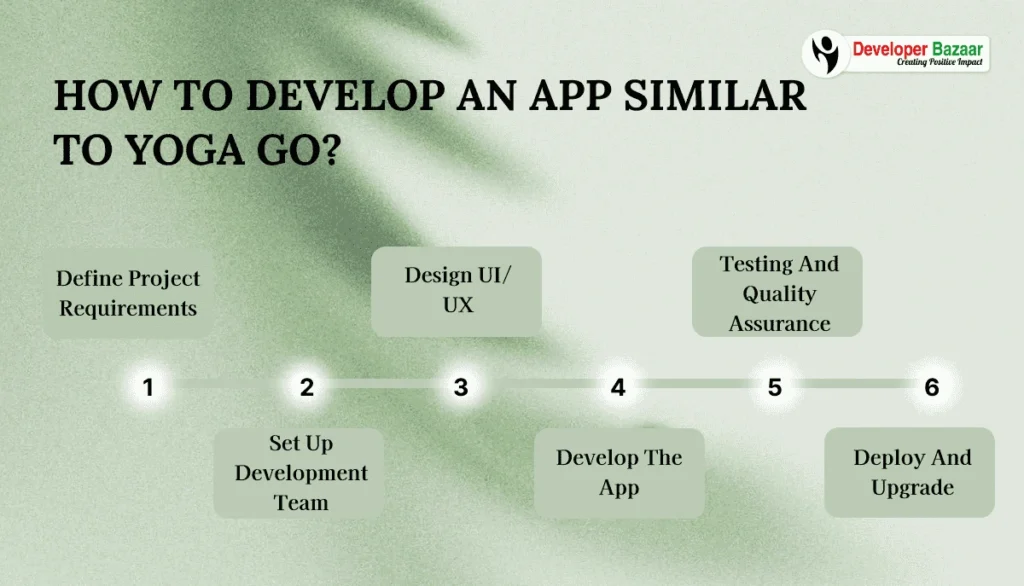
1. Define Project Requirements
First of all, you need to define the goals, like your target audience for which you will develop the app, similar to Yoga Go. Also, you need to determine the type of app you want to build, like native or cross-platform.
Moreover, decide what AI features, content types, and monetization strategies you will leverage to generate revenue from your Yoga Go-like app.
2. Set Up Development Team
For the development team, you can hire experienced mobile app developers who have expertise in building AI-powered fitness and wellness applications similar to Yoga Go.
Another cost-effective option is outsourcing the project to a top fitness app development company with high ratings and positive client testimonials.
The benefit of this option is that they will take care of the development part completely, freeing you to focus on your business and content strategy.
3. Design UI/UX
At this step, design the user interfaces for your app like Yoga Go. Study other AI-powered fitness apps in the market to take ideas and inspiration, and create your design.
Follow best practices to create an intuitive and calming interface that promotes wellness and makes yoga practice effortless. For this, you can use designing software like Adobe Photoshop or Figma.
4. Develop the App
After designing the UI/UX, start developing the frontend and backend infrastructures for your app, like Yoga Go. Integrate third-party services and APIs to enhance your app’s functionalities and align it with user expectations.
You can also add cutting-edge technologies like artificial intelligence, machine learning, and computer vision to enhance your app’s pose detection accuracy, personalize user experiences, and make your app stand out in the competitive wellness market.
5. Testing and Quality Assurance
Rigorously test your app like Yoga Go to identify if there are any bugs or glitches. If found, fix them and also check your app’s performance and compatibility on different devices and platforms.
You can also release its Beta version, gather feedback, and make relevant changes to the app, based on that feedback, before the release.
6. Deploy and Upgrade
Once testing is done, release your Yoga Go-like app on the Google Play Store and App Store. Follow their respective guidelines to approve your app at the earliest attempt.
Also, keep upgrading your application with new versions, yoga content, functionalities, and user interfaces, to keep your app relevant for longer.
Monetization Strategies For an App Similar to Yoga Go
One of the biggest advantages of building a Yoga Go-like app is the ability to generate consistent revenue through multiple wellness-focused channels. The following are some proven monetization strategies that you can implement for your Yoga Go clone app.
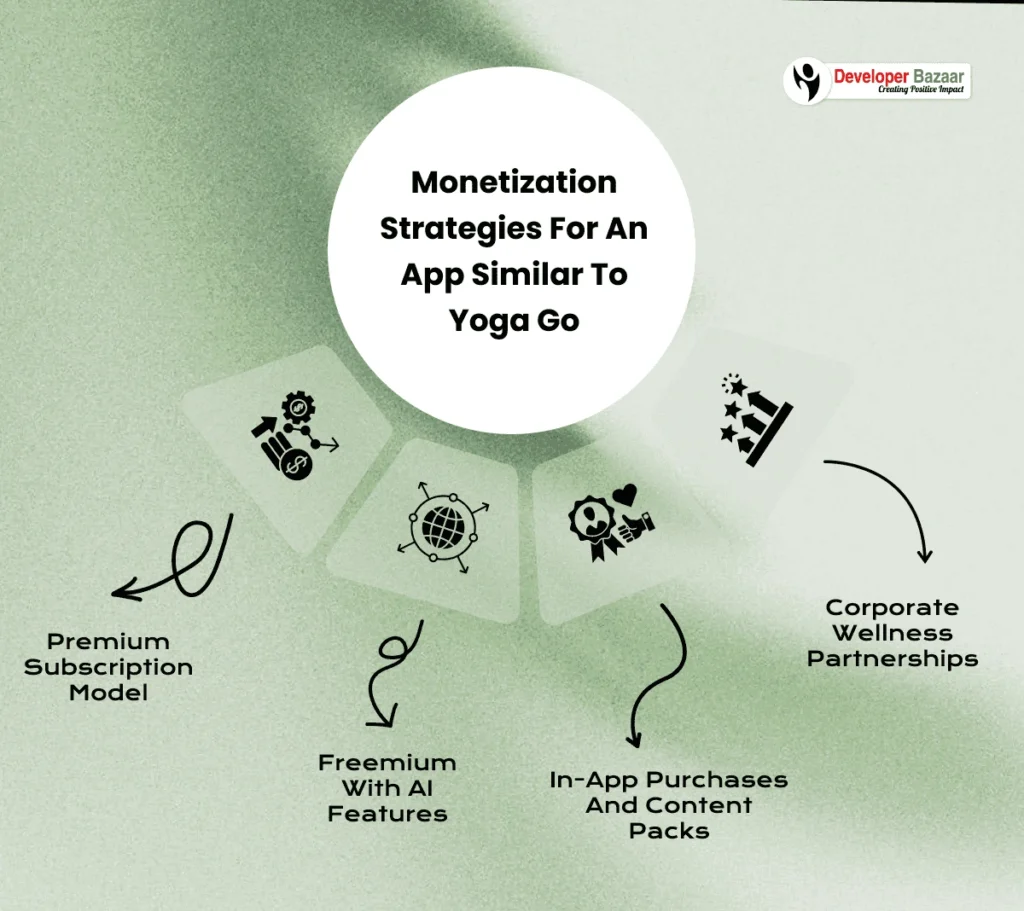
Premium Subscription Model
This will be your core monetization strategy. Offer basic yoga sessions for free while charging a monthly fee for premium features like AI pose correction, personalized workout plans, and advanced content.
Yoga Go charges approximately $4.42 per month for annual subscriptions, demonstrating that users are willing to pay for quality yoga instruction and intelligent features.
Freemium with AI Features
Implement a freemium model where basic yoga videos are free, but AI-powered pose detection, real-time feedback, and AI personalized recommendations require a premium subscription.
This approach allows users to experience your app’s value before committing to paid features, improving conversion rates and user retention.
In-App Purchases and Content Packs
Offer specialized yoga programs, meditation sessions, or advanced courses as one-time purchases. You can also sell premium content packs targeting specific needs like prenatal yoga, advanced poses, or therapeutic sessions for additional revenue streams.
Corporate Wellness Partnerships
Partner with businesses to provide employee wellness programs through your yoga app. Corporate contracts can generate a certain amount annually per company, depending on employee count and feature requirements.
This B2B approach provides stable recurring revenue while expanding your user base through workplace wellness initiatives.
Technology Stack for Yoga Go-like App Development
Here is a comprehensive technology stack for creating an app like Yoga Go:
| Component | Technology Stack |
|---|---|
| Mobile Frontend | React Native, Flutter, Swift (iOS), Kotlin (Android) |
| AI/ML Integration | TensorFlow, PyTorch, MediaPipe, OpenCV |
| Pose Detection | MediaPipe Pose, TensorFlow Lite, Core ML |
| Backend Development | Node.js, Python Django, Ruby on Rails |
| Database | PostgreSQL, MongoDB, Firebase, Amazon RDS |
| Cloud Infrastructure | AWS, Google Cloud Platform, Microsoft Azure |
| Video Streaming | AWS Elemental, Vimeo API, JW Player |
| Real-time Processing | WebRTC, Socket.io, Firebase Realtime |
| Analytics | Google Analytics, Mixpanel, Firebase Analytics |
| Payment Integration | Stripe, PayPal, Apple Pay, Google Pay |
| Push Notifications | Firebase Cloud Messaging, OneSignal |
| Content Management | Contentful, Strapi, Custom CMS |
| Testing | Jest, Detox, XCTest, Espresso |
This technology stack is optimized for AI-powered yoga app development. Technology selection may vary based on specific requirements, budget constraints, and performance objectives.
Conclusion
Yoga Go is one of the most popular AI-powered yoga applications globally. With the growing demand for personalized wellness solutions and intelligent fitness coaching in 2025, entrepreneurs have a golden opportunity to build similar apps and tap into this thriving market.
To develop a Yoga Go-like app, the development costs start from $20,000 for a basic app with essential features and go up to $80,000+ for a complex app with advanced AI integration, pose detection, and premium functionalities.
If you want to optimize the cost to develop an app like Yoga Go, then partner with Developer Bazaar Technologies. Experienced AI development company who have developed top wellness and fitness apps with AI integration, pose detection technology, and subscription monetization systems.
For more information, feel free to contact us.

FAQs
Q1. What's the real cost to develop an app like Yoga Go?
Development costs range from $20,000-$40,000 for basic apps to $60,000-$80,000+ for AI-powered platforms. Advanced pose detection and machine learning features typically add $15,000-$30,000 to base development costs.
Q2. Why do many yoga apps fail in their first year?
Most entrepreneurs underestimate ongoing costs like content creation, cloud infrastructure, and user acquisition. Modern users expect AI features from day one, not as future updates.
Q3. Should I build for iOS, Android, or both platforms?
Build for both using cross-platform development, which saves 30-40% compared to separate native builds. Yoga app users are distributed across both platforms, so limiting to one platform reduces your potential market significantly.
Q4. Is AI pose detection worth the extra development cost?
Absolutely. AI-enabled yoga apps can charge a monthly fee versus basic video apps. User retention increases 30-50% with intelligent features, making AI integration essential for competitive success.
Q5. What hidden costs should I expect beyond development?
Content creation with professional instructors, ongoing video production, cloud hosting, marketing campaigns, and app maintenance (15-20% of development cost annually).
Q6. When should I launch my yoga app?
Launch when you have 3-6 months of quality content ready and core AI features working reliably. The wellness market grows consistently, so focus on quality over speed to market.
Q7. How long does it take to develop an AI yoga app?
Expect 6-9 months for a complete AI-powered yoga app. AI implementation, content creation, and testing are the main bottlenecks. Plan additional time for app store approval and initial user feedback integration.
Q8. Can I start with a basic app and add AI later?
Not recommended in 2025. Users expect intelligent features immediately. Rebuilding a basic app with AI can cost 40-60% more than building AI capabilities from the start due to architecture changes required.
Q9. What's the difference between the USA and offshore development teams in India?
USA teams charge $100-$200/hour but offer better communication and market understanding. Offshore teams cost $15-$30/hour with comparable technical quality. Many projects use hybrid approaches for optimal cost-quality balance.
Q10. What's the realistic timeline to profitability?
12-18 months with proper execution and marketing. Budget per user acquisition, ongoing content costs, and 15-20% annual maintenance. Success depends on consistent feature updates and user engagement strategies.

RM Mishra
Co-Founder
Developer Bazaar technologies