



Table of Contents
ToggleWhy Pet Dog Translator Apps Are Gaining Popularity
The answer is simple: emotional connection and understanding. Modern pet owners treat their dogs as integral family members rather than simple animals, creating demand for sophisticated communication tools that provide genuine insights into their pets’ emotional states, needs, and behaviors.
Pet translator apps leverage artificial intelligence and machine learning to analyze canine vocalizations, body language, and behavioral patterns. These apps promise real-time emotional understanding and behavior interpretation, making them perfect for today’s tech-savvy pet owners who want deeper connections with their companions.
Moreover, these AI-powered pet communication apps offer intuitive interfaces, personalized insights, and health monitoring capabilities that enhance the pet ownership experience. As a result, more users are embracing these platforms, driving consistent growth in the pet technology market.
Benefits of Investing in Pet Dog Translator App Development
Developing a pet dog translator app provides various advantages to entrepreneurs. The top benefits are as follows:
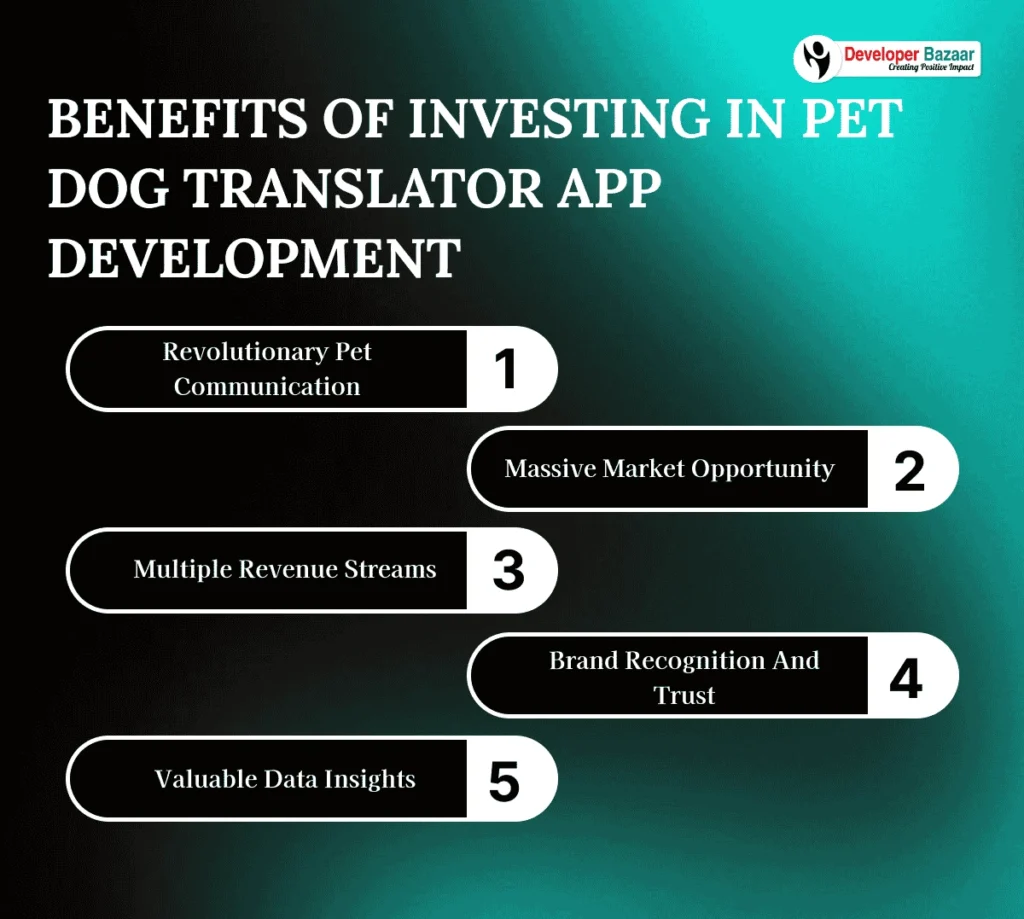
Revolutionary Pet Communication
Pet translator apps enable breakthrough communication between humans and their canine companions. Using advanced AI algorithms, these apps can decode barks, whines, and body language into understandable emotional states and needs, creating unprecedented bonding opportunities for pet owners.
Massive Market Opportunity
The pet technology sector offers exceptional growth potential, with the AI pet tech market expected to reach $101 million by 2033. Early entry into pet translator app development positions entrepreneurs to capture significant market share in this rapidly expanding industry.
Multiple Revenue Streams
Entrepreneurs can monetize pet translator apps through diverse channels including premium subscriptions, in-app purchases for training programs, affiliate partnerships with pet brands, veterinary service referrals, and research data licensing, creating sustainable income sources.
Brand Recognition and Trust
A feature-rich and accurate pet translator app powered by cutting-edge AI technologies enhances users’ pet ownership experiences. This helps build trust and loyalty among pet owners, establishing your brand as the go-to solution for pet communication technology.
Valuable Data Insights
Pet translator app development allows you to collect behavioral data (with user consent) that provides valuable insights into canine communication patterns, health indicators, and emotional states. This data can optimize your services, improve AI accuracy, and support veterinary research partnerships.
How to Develop a Pet Dog Translator App?
Now that you know the benefits, let’s jump into the step-by-step process to develop a pet dog translator app.
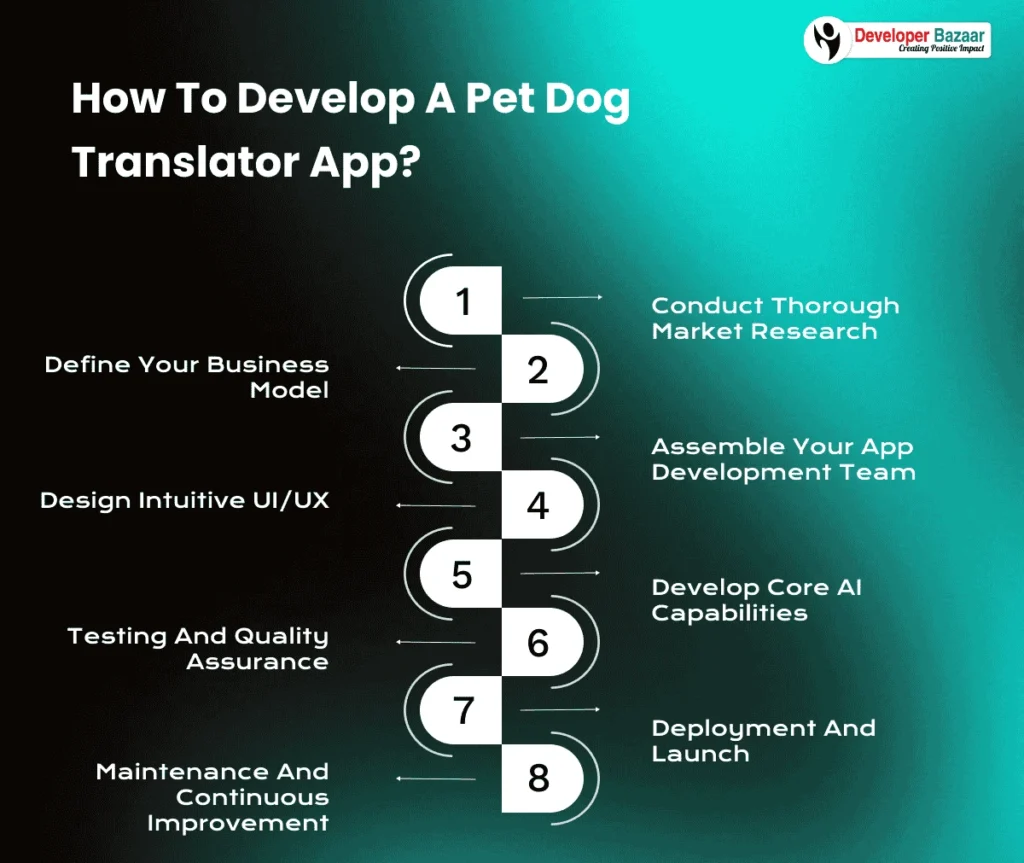
1. Conduct Thorough Market Research
Before you start to build your pet dog translator app, conduct detailed market research to understand your target pet owners and analyze the competitive landscape. Study successful platforms like Traini and BowLingual to identify gaps and opportunities in the market.
Also, understand the latest AI trends in pet communication, including real-time emotion detection, behavioral analysis, and health monitoring integration. This research will help you build a competitive and innovative app that meets genuine market needs.
2. Define Your Business Model
After conducting market research, determine your business model. Decide whether you’ll focus on basic emotion detection (freemium model) or advanced behavioral analysis with premium features. Choose between subscription-based pricing or one-time purchase options.
Also, plan your monetization strategies, including premium subscriptions, training program sales, affiliate partnerships, and data licensing opportunities. Defining these elements beforehand will streamline your development journey and ensure sustainable revenue generation.
3. Assemble Your App Development Team
Developing a pet dog translator app requires specialized expertise in AI/ML, audio processing, and mobile app development. The unique challenges of animal communication analysis demand developers experienced in machine learning, natural language processing, and behavioral pattern recognition.
We recommend hiring mobile app developers who have built AI-powered applications or worked with audio processing technologies. You can also partner with a top mobile app development company that specializes in AI and machine learning solutions.
4. Design Intuitive UI/UX
Engage your development team’s designers to create user-friendly interfaces for your pet translator app. The design should be simple, emotionally engaging, and easy to navigate during real-time interactions with pets.
Study successful pet apps to understand design principles that resonate with pet owners. Focus on visual elements that convey emotional states clearly, use calming colors that don’t agitate animals, and ensure the interface works well in various lighting conditions since pet interactions happen throughout the day.
5. Develop Core AI Capabilities
Now, engage your AI developers to build the machine learning infrastructure for your pet translator app. Start with developing a minimum viable product (MVP) featuring basic bark recognition and simple emotion detection capabilities.
Implement audio processing algorithms that can filter background noise, identify individual dog vocalizations, and analyze vocal patterns for emotional states. Integrate computer vision capabilities to analyze body language and facial expressions for comprehensive behavioral understanding.
6. Testing and Quality Assurance
Once development is completed, extensively test your pet dog translator app with real dogs across different breeds, ages, and environments. Accuracy testing is crucial for pet translator apps since users expect reliable emotional and behavioral insights.
Conduct beta testing with diverse pet owners to gather feedback on usability, accuracy, and practical value. Test the app’s performance in various acoustic environments, lighting conditions, and with different dog personalities to ensure robust functionality.
7. Deployment and Launch
Launch your pet dog translator app on Google Play Store and App Store, ensuring compliance with both stores’ guidelines for AI and pet-related applications. Create compelling app store listings that highlight the emotional benefits and practical value of understanding your pet better.
Promote the app through pet influencer partnerships, veterinary clinic collaborations, and targeted social media campaigns reaching dog owners interested in technology and pet wellness solutions.
8. Maintenance and Continuous Improvement
Post-launch, monitor your pet translator app’s performance using key metrics like translation accuracy, user engagement, and retention rates. Pet translator apps require continuous AI model improvements as you collect more behavioral data.
Regular updates should include expanded breed-specific recognition, improved accuracy algorithms, new behavioral insights, and enhanced user experience features. Plan for quarterly AI model retraining to maintain and improve translation accuracy.
Top Features to Integrate into a Pet Dog Translator App
The following are the top features that you can integrate into your pet dog translator app. We have distributed the features into three segments – Users, Admin, and Advanced AI Features, to make it easy for you to understand.
User App Features
• Real-Time Bark Translation
Advanced AI algorithms that instantly analyze and translate barks, whines, and growls into understandable emotional states and needs.
• Emotion Detection Dashboard
Visual interface displaying your dog’s current emotional state, stress levels, and behavioral patterns through intuitive graphics and color-coded indicators.
• Multi-Dog Profile Management
Support for multiple pets with individual profiles, breed-specific communication patterns, and personalized behavioral baselines for accurate translation.
• Voice-to-Bark Communication
Two-way communication feature allowing owners to send simple messages to their dogs through synthesized canine sounds and tones.
• Behavioral Pattern Analytics
Long-term tracking of communication patterns, mood changes, and behavioral trends to identify health concerns or emotional needs.
• Health Alert System
AI-powered early warning system that detects unusual behavioral changes that might indicate health issues or distress.
• Training Integration
Built-in training programs that use translation insights to improve communication and strengthen the human-dog bond through positive reinforcement.
• Emergency Communication Detection
Advanced algorithms that identify urgent or distress signals, immediately alerting owners to potential emergencies or health crises.
Admin Panel Features
• AI Model Management
Comprehensive dashboard to monitor translation accuracy, update machine learning models, and analyze performance across different dog breeds and environments.
• User Behavior Analytics
Detailed insights into app usage patterns, feature engagement, translation request frequency, and user satisfaction metrics for product optimization.
• Content and Training Data Management
System to update behavioral databases, add new breed-specific communication patterns, and manage the continuous learning dataset for AI improvement.
• Customer Support Integration
Advanced ticketing system for handling user queries, translation accuracy reports, and technical issues with integrated pet behavior expertise.
• Revenue and Subscription Tracking
Comprehensive monitoring of subscription metrics, premium feature usage, in-app purchases, and monetization performance across user segments.
Advanced AI Features
• Computer Vision Analysis
Camera-based body language interpretation that combines with audio analysis for comprehensive emotional and behavioral understanding.
• Predictive Health Monitoring
Machine learning algorithms that analyze communication changes to predict potential health issues before they become serious problems.
• Breed-Specific Communication Patterns
Specialized AI models trained on breed-specific vocalizations and behaviors for more accurate translation and cultural canine understanding.
• Environmental Context Awareness
Smart algorithms that consider location, time, weather, and surrounding factors when interpreting pet communications for enhanced accuracy.
• Continuous Learning Adaptation
Self-improving AI that learns from individual pet interactions, becoming more accurate and personalized over time through advanced machine learning.
Technology Stack to Build a Pet Dog Translator App
Here is a comprehensive technology stack to develop a pet dog translator app:
| Component | Technology Stack |
|---|---|
| Frontend (Mobile App) | React Native or Flutter (cross-platform), Swift (iOS), Kotlin (Android) |
| AI/ML Framework | TensorFlow, PyTorch, OpenAI Whisper (adapted for animal sounds) |
| Backend Development | Node.js, Python Django, Ruby on Rails |
| Database | PostgreSQL, MongoDB, Firebase Realtime Database |
| Audio Processing | Web Audio API, Audio Toolkit, Core Audio (iOS) |
| Computer Vision | OpenCV, Core ML, TensorFlow Lite |
| Cloud Infrastructure | AWS, Google Cloud Platform, Microsoft Azure |
| Real-time Processing | Socket.IO, WebRTC, Firebase Cloud Functions |
| Authentication | Firebase Auth, OAuth 2.0, JWT (JSON Web Tokens) |
| Payment Gateway | Stripe, PayPal, Apple Pay, Google Pay |
| Push Notifications | Firebase Cloud Messaging (FCM), OneSignal |
| Analytics & Monitoring | Google Analytics, Firebase Analytics, Mixpanel |
| API Integration | RESTful APIs, GraphQL, third-party pet service APIs |
*This is the recommended technology stack for developing a pet dog translator app. However, technology selection may vary based on specific AI requirements, accuracy goals, and scalability needs.
Cost to Develop a Pet Dog Translator App
In this section, you will learn about the costs to develop a pet dog translator app. The costs depend on multiple factors, such as AI complexity, audio processing capabilities, computer vision integration, the technology stack you use, your development team size and location, and more.
To make it easier for you to understand, we have provided a table with development cost estimations. Have a look:
| App Complexity | Development Time | Estimated Development Costs (in $) |
|---|---|---|
| Standard Platform | 3-6 months | $20,000 to $40,000 |
| Advanced Solution | 6-9 months | $35,000 to $60,000 |
| Enterprise Platform | 12+ months | $60,000 to $80,000 |
Please note that these are only estimations. Actual costs may vary based on AI model complexity, training data requirements, and advanced feature integration.
Monetize Your Pet Dog Translator App
For developing a pet dog translator app, you invest significant resources in AI development, data collection, and specialized expertise. As a business, you must generate revenue from your app to sustain operations, improve AI accuracy, and scale your pet communication platform.
Here are the top proven monetization strategies for your pet dog translator app:
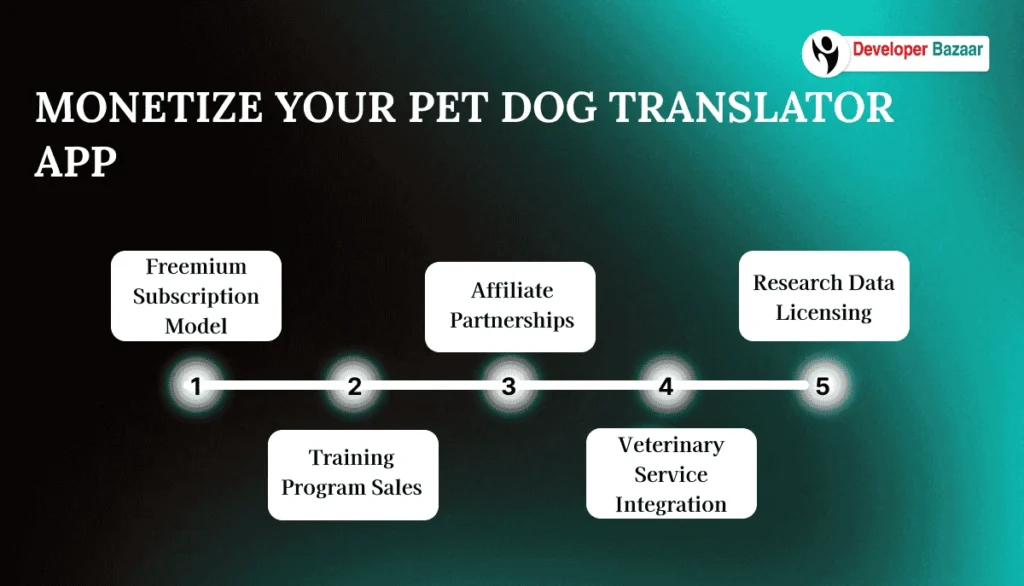
Freemium Subscription Model
This is the most effective strategy used by successful pet tech platforms. Offer basic bark recognition and simple emotion detection for free, then charge a decent amount monthly for premium features like advanced behavioral analysis, health monitoring, and multi-pet support.
This model maximizes user acquisition while converting engaged pet owners to paid subscribers who value deeper insights into their pets’ communication patterns and emotional well-being.
Training Program Sales
Generate revenue by selling specialized digital training programs developed in partnership with certified dog trainers. The price of these programs varies, offering pet owners professional guidance enhanced by AI-powered communication insights.
These programs provide high-value content while leveraging your app’s translation capabilities to create more effective training experiences and stronger human-dog bonds.
Affiliate Partnerships
Partner with pet product brands, toy manufacturers, and wellness companies to recommend products based on your app’s behavioral insights. Earn commissions ranging from 5-15% on sales generated through your platform.
This strategy provides additional value to users by suggesting relevant products while creating passive income streams that scale with your user base.
Veterinary Service Integration
Collaborate with veterinary clinics and pet health services to offer referral programs and telemedicine consultations. Earn referral fees while providing users with professional health insights based on behavioral changes detected by your app.
This creates a valuable service ecosystem while generating revenue from health-conscious pet owners seeking professional guidance.
Research Data Licensing
License anonymized behavioral communication data to academic institutions, veterinary researchers, and pet industry companies developing new products and services. This creates high-value revenue streams while contributing to animal behavior research.
Ensure strict privacy compliance and user consent while monetizing the valuable dataset your app generates through daily usage.
Conclusion
So, this is your complete guide to developing a pet dog translator app in 2025. As the demand for AI-powered pet communication solutions reaches an all-time high, it is the perfect time to build an innovative pet translator app for the growing market.
Developing a pet dog translator app will provide various benefits, including revolutionary pet communication capabilities, access to a massive market opportunity, multiple revenue streams, enhanced brand recognition, and valuable behavioral data insights that can drive continuous improvement.
The AI pet tech market’s projected growth to $101 million by 2033 demonstrates the exceptional opportunity available for well-executed platforms. With proper AI implementation, user-focused design, and strategic monetization, your pet translator app can capture significant market share while genuinely improving the lives of pets and their owners.
So, what are you waiting for? Follow this guide to build your app today. If you want professional assistance, reach out to Developer Bazaar Technologies, the leading AI development company specializing in pet technology solutions.
We have developed numerous AI-powered applications and pet tech platforms for startups and enterprises, helping them achieve market success and user engagement. You can explore our portfolio for detailed case studies and success stories.
FAQs
Q1. What is a pet dog translator app?
A pet dog translator app is an AI-powered mobile application that analyzes canine vocalizations, body language, and behavioral patterns to interpret and translate them into understandable emotional states, needs, and communication for pet owners.
Q2. How much does it cost to develop a pet dog translator app?
Basic MVP development costs $20,000-$40,000, while advanced AI-powered platforms with comprehensive features range from $35,000 to $60,000. Costs vary based on AI complexity, training data requirements, and advanced feature integration.
Q3. How long does pet dog translator app development take?
Development typically takes 4-6 months for basic MVP, 6-9 months for standard platforms, and 9-15 months for advanced solutions with comprehensive AI capabilities, computer vision, and multi-pet support features.
Q4. What makes pet translator apps accurate?
Accuracy depends on advanced AI models trained on diverse canine vocalization datasets, machine learning algorithms that adapt to individual pets, computer vision for body language analysis, and continuous model improvements based on user feedback.
Q5. What are the key revenue streams for pet translator apps?
Primary monetization includes freemium subscriptions, training program sales, affiliate partnerships with pet brands, veterinary service referrals, and research data licensing to academic institutions.
Q6. Which technologies are essential for pet translator app development?
Core technologies include AI/ML frameworks (TensorFlow, PyTorch), audio processing libraries, computer vision tools, real-time processing capabilities, cloud infrastructure, and mobile development frameworks like React Native or Flutter.
Q7. How can I ensure my pet translator app succeeds in the market?
Success factors include focusing on translation accuracy, user-friendly design, continuous AI improvements, strategic partnerships with veterinarians and trainers, effective monetization strategies, and building trust through transparent privacy practices.
Q8. How can I start developing my pet translator app with Developer Bazaar Technologies?
You can contact our AI and mobile development team by clicking here or emailing us at [email protected] to start developing your innovative pet translator app today.

RM Mishra
Co-Founder
Developer Bazaar technologies