With the rise of fintech, online payments have become faster and easier than ever. Businesses and individuals can enjoy instant payments and quick settlements, all with the help of payment gateways.
A payment gateway is a digital system that securely handles every transaction, making it essential for any website or app that accepts online payments. It also offers the convenience of contactless payments, keeping customer information safe.
But with so many options available today, choosing the right payment gateway can be confusing.
In this comprehensive guide, we’ll cover how to integrate a payment gateway, how to choose the right one for your business, and everything else you need to set up a secure and seamless payment system.
First, we need to understand what a payment gateway is and how it works, so we begin with this.
What is a Payment Gateway?
A payment gateway is a secure digital service that connects your app or website with banks and payment providers. It acts as a middleman between the customer and the business.
Think of it like a cashier in a store. When you buy something, the cashier takes your money, checks if it’s valid, and then gives the shopkeeper the payment. Similarly, a payment gateway checks your card or UPI details, processes them safely, and transfers the money to the business.
With a payment gateway for your app, you can:
Accept multiple payment methods like cards, wallets, and net banking.
Make sure transactions are secure with encryption and fraud detection.
Provide a smooth checkout experience to your users.
Without a payment gateway, your app or website won’t be able to collect payments securely.
How Does a Payment Gateway Work?
A payment gateway may look simple to customers, but it is more complex in the background. Here’s a step-by-step process:
Step 1: Customer Makes a Purchase
A user adds products or services to their cart and chooses to pay. They pick their payment method, such as a debit card, credit card, UPI, or digital wallet.
Step 2: Redirect to Payment Gateway
The app or website redirects the customer to the payment gateway. This can happen inside the app or on a third-party secure page.
Step 3: Secure Data Encryption
The payment details (like card number or UPI ID) are encrypted, so no hacker can read them. The gateway also runs fraud checks using AI, geolocation, and security filters.
Step 4: Bank Authorization
The payment gateway contacts the customer’s bank through the card network (Visa, MasterCard, Rupay). The bank checks if the customer has enough balance and if the details are correct.
If approved → Transaction goes through.
If declined → Customer gets a failure message and can retry.
Step 5: Settlement
Once approved, the customer’s bank sends the money to the merchant’s bank (acquiring bank). The business receives the amount in its account, usually within 1 – 3 working days.
This entire process happens within seconds to give users a smooth experience.
Example of a Payment Gateway
For example, Razorpay is one of the most popular gateways.
A customer shops on an e-commerce app.
At checkout, they choose Razorpay to make the payment.
Razorpay encrypts its card/UPI details and runs fraud checks.
It communicates with the customer’s bank and the merchant’s bank for approval.
Once confirmed, Razorpay settles the money into the seller’s account.
This simple flow allows the buyer’s data to be safe, the seller gets paid, and the process is simple and effortless.
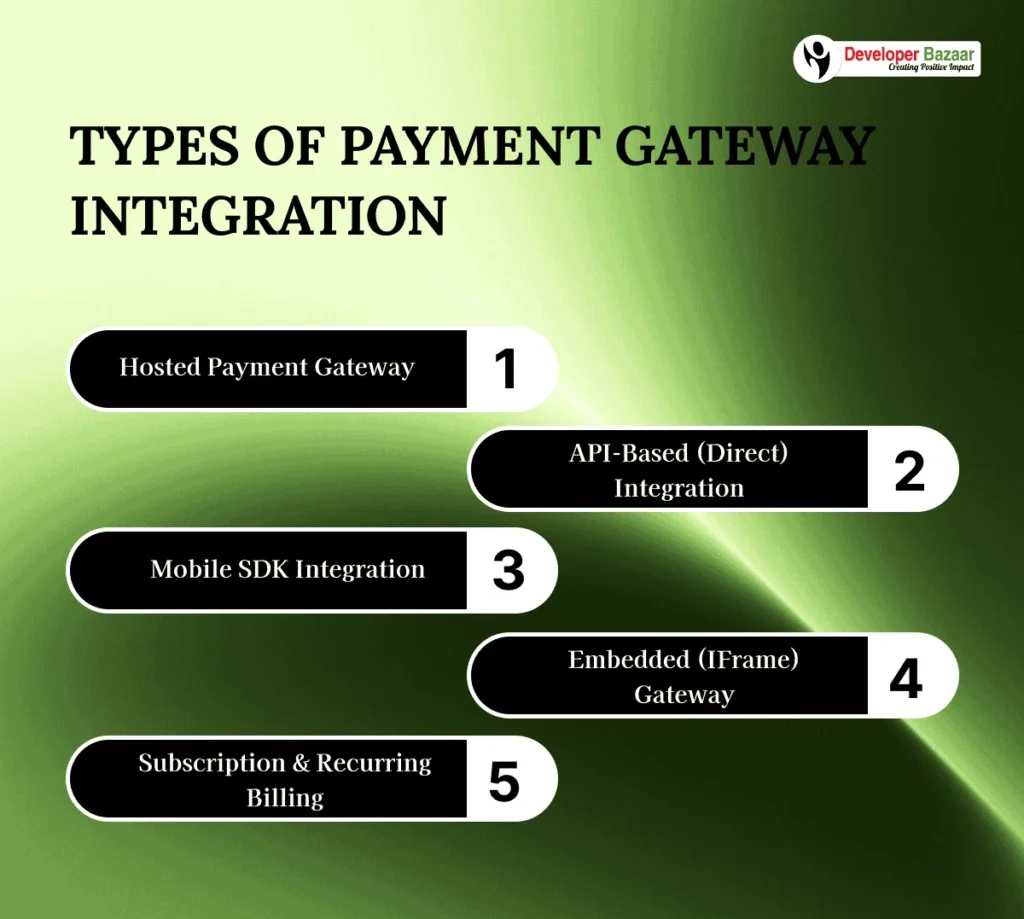
What are the Different Types of Payment Gateway Integration?
Choosing the right type of payment gateway is very important because it directly impacts both user experience and security. Here are the main types of payment gateway integrations you can consider:
1. Hosted Payment Gateway
A hosted payment gateway redirects customers to a third-party page, such as PayPal or Razorpay, to complete their payment. The biggest advantage here is that the gateway provider takes care of all the security checks and compliance requirements. This makes setup easy and highly secure. However, since users have to leave your website or app to make the payment, it may sometimes lead to a drop in conversions.
2. API-Based (Direct) Integration
In API-based integration, the payment is processed directly on your website or app using an API. This gives you complete control over the checkout design and allows you to provide a fully branded experience to your customers. The downside is that it requires you to follow strict security rules, such as PCI DSS compliance, which can be more complex for businesses.
3. Mobile SDK Integration
Mobile SDK integration is designed for apps and enables payments directly within the mobile application. Developers add a software development kit (SDK) to create a smooth and secure in-app payment experience. This type of integration is great for mobile-first businesses. However, it does require skilled developers to implement correctly.
4. Embedded (iFrame) Gateway
With an embedded gateway, the payment form is displayed directly inside your website or app through an iframe. This means users can complete their payment without being redirected elsewhere, while sensitive payment data is still securely managed by the payment provider. It offers a balance of seamlessness and security, but customization options are usually limited.
5. Subscription & Recurring Billing
This type of payment gateway is ideal for businesses that charge customers regularly, such as Netflix or SaaS platforms. It allows payments to be deducted automatically on a monthly or yearly basis. For users, it offers convenience since they don’t have to pay manually every time, and for businesses, it provides a stable and predictable revenue stream. However, it requires strong security systems to safely store and manage customer payment details.
In the end, the right payment gateway depends on your business model, budget, and customer needs. A small online shop may go for a hosted gateway, while a SaaS business would likely prefer recurring billing.
How to Set Up Payment Gateway Integration For a Mobile App
If you’re building a mobile app and want to integrate a payment gateway, below are the steps you can follow:
Step 1: Identify Business Needs
Decide if your app is for eCommerce, subscriptions, or a marketplace. Based on that, list the payment methods you need: cards, UPI, BNPL, or wallets.
Step 2: Choose a Payment Gateway Provider
Compare providers like Stripe, PayPal, Razorpay, or PayU. Check their transaction fees, payout cycle, supported countries, and extra features.
Step 3: Ensure Legal Compliance
Register your business, open a current account, and complete KYC verification. Most providers will need your tax ID, bank details, and company registration documents.
Step 4: Integrate SDK or API
For Android: Add SDK in build. gradle.
For iOS: Use CocoaPods or Swift Package Manager.
Secure your integration with HTTPS, tokenization, and authentication.
Step 5: Test Transactions
Use sandbox/test mode to try out transactions without real money. Test success, failure, expired cards, and network errors.
Step 6: Deploy in Production
Switch to live API keys and launch the integration. Monitor transactions, fraud alerts, and user experience.
Step 7: Optimize & Scale
Use analytics to improve checkout flow.
Negotiate lower fees as your transactions grow.
Add global payment methods when expanding internationally.
With the help of a professional app development company, you can streamline this process and avoid errors.
Key Considerations for Setting Up an Online Payment Gateway Integration
When setting up an online payment gateway integration, you must consider several factors to make sure simple, secure, and reliable transactions. Ignoring these aspects can lead to failed payments, poor user experience, or even financial losses.
1. Account Type
Businesses can choose between dedicated accounts and aggregate accounts. Dedicated accounts give you full control but take longer to set up and cost more. Aggregate accounts (like Stripe or PayPal) are cheaper and quicker but have limited customization.
2. Security Compliance
Every business that accepts payments must follow PCI DSS (Payment Card Industry Data Security Standards). This allows sensitive data like card numbers is encrypted and safe. Even if you use a third-party service, you must implement strong security features like tokenization, SSL, and fraud checks.
3. Dispute Management
Sometimes, customers may face failed transactions or raise chargebacks. Without a proper dispute resolution system, you risk losing trust. Using tools like automated refunds, chargeback management systems, and customer notifications helps improve reliability.
4. Multi-Currency & Cross-Border Payments
If you want to sell globally, your gateway should support multi-currency transactions. Features like real-time currency conversion and local payment methods (e.g., UPI in India, Alipay in China) make global customers feel comfortable and improve success rates.
5. Speed & Reliability of Transactions
Customers abandon payments if they face delays. Choose a gateway with 99.9% on-time and fast processing to avoid failures. Quick and reliable payments improve customer satisfaction and reduce cart abandonment.
6. Payment Methods & Regional Preferences
Your customers may prefer different methods like debit cards, wallets, or BNPL. Offering multiple payment options increases conversions. Supporting regional preferences ensures local customers don’t drop off because their favorite method isn’t available.
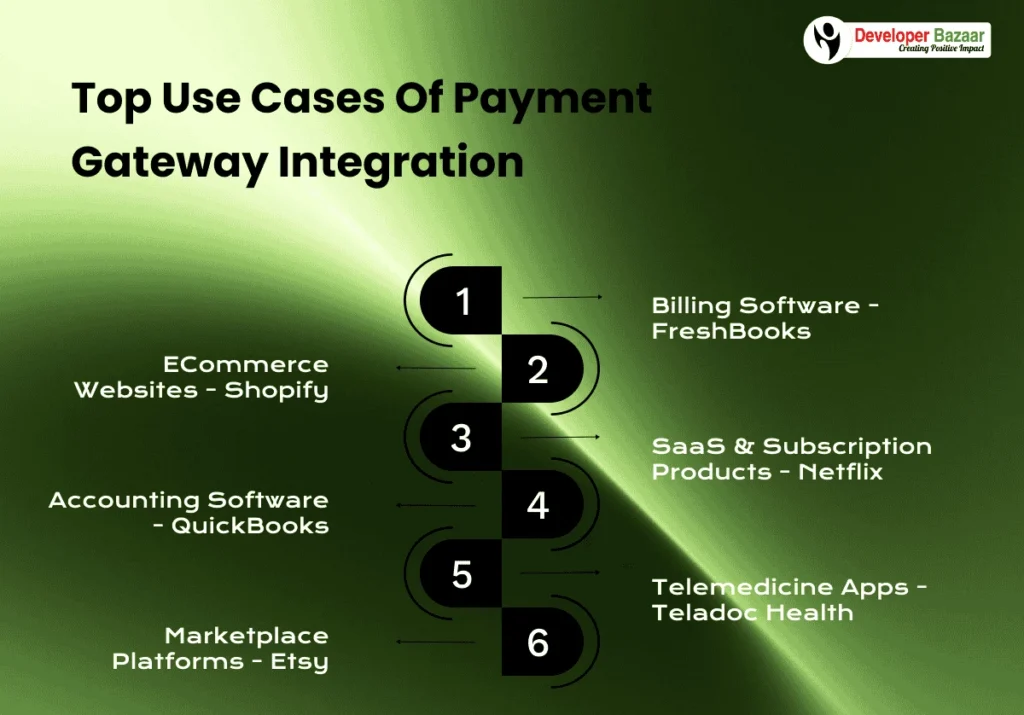
Top Use Cases of Payment Gateway Integration
A payment gateway isn’t limited to just eCommerce. It enables in many industries and makes payments simple across different platforms.
Below are the top use cases with examples:
1. Billing Software - FreshBooks
Billing tools like FreshBooks use Stripe and PayPal integration to automate invoicing, renewals, and late fees. Customers can pay invoices instantly, reducing delays in payments and improving business cash flow.
2. eCommerce Websites - Shopify
eCommerce platforms like Shopify integrate with PayPal, Stripe, and Klarna. This allows customers to choose from multiple payment methods, enjoy quick checkouts, and trust that transactions are secure.
3. SaaS & Subscription Products - Netflix
Netflix uses Adyen and Stripe to handle recurring subscriptions. Their payment system supports global currencies, automated billing, and even AI-based churn prediction, ensuring smooth renewals.
4. Accounting Software - QuickBooks
QuickBooks integrates with Stripe and Square for automated invoicing and reconciliation. This means businesses don’t have to manually track payments, making tax compliance and financial management easier.
5. Telemedicine Apps - Teladoc Health
In telemedicine, patients pay for online consultations and subscriptions. Teladoc integrates with PayPal and Stripe to enable smooth, secure payments while ensuring compliance with healthcare regulations.
7. Marketplace Platforms - Etsy
Marketplaces like Etsy use Adyen and Payoneer to manage multi-vendor payments. Their system ensures that vendors get paid on time, buyers feel secure, and international transactions are handled without issues.
These examples show how implementing payment gateway integration boosts trust, automates billing, and ensures smooth business operations.
Future of Online Payment Gateway Integration?
The payment industry is evolving fast, with FinTech innovation changing how people pay. The future of payment integration services will focus on speed, security, and frictionless experiences.
1. Rise of NFC Payments
Near Field Communication (NFC) allows users to tap their phone to pay instantly. Apps like Apple Pay and Samsung Pay already use this technology, making checkouts faster and reducing dependency on cards.
2. Bitcoin & Cryptocurrency Payments
Cryptocurrency is no longer a buzzword. Businesses are starting to integrate Bitcoin and other cryptos into their apps. This makes payments faster, borderless, and attractive to tech-savvy users.
3. Biometric Authentication
Fingerprint scans, face recognition, and even voice authentication are becoming part of payment gateways. This boosts security while making checkout faster, no need to type long passwords every time.
4. Super Apps
Apps like WeChat, Grab, and Paytm are combining payments, shopping, banking, and even ride-hailing in one app. These “super apps” are changing the way how consumers use financial services.
5. QR Code Payments
QR code payments are rising in markets like India and Southeast Asia. Apps like Google Pay and Alipay make it easy to scan and pay instantly. This method is cheap, fast, and widely accessible.
These innovations prove that the future of online payment gateway integration will be smarter, faster, and more inclusive. Businesses that adapt early will gain customer trust and increase revenue.
How Much Does a Payment Gateway Cost?
The cost of a payment gateway depends on the provider and the type of transactions you handle. Generally, you can expect:
Setup Fees: $0 – $50,000 depending on the gateway.
Annual Maintenance Charges (AMC): $1,000 – $5,000 per year.
Transaction Charges: Usually range between 1.5% and 3% per transaction.
Some providers offer free setup with only transaction fees, while others may charge a one-time integration fee. It’s important to compare pricing models before choosing the right one.
Start Your Payment Gateway Integration with Developer Bazaar Technologies
At Developer Bazaar Technologies, we make it easy for businesses to set up secure and reliable payment gateways on their websites and mobile apps. Whether you need to accept UPI, credit and debit cards, net banking, or Buy Now Pay Later (BNPL) payments, our team ensures a smooth and hassle-free integration.
We also take care of all security standards and compliance requirements, so your customers can enjoy a safe checkout experience. With our expertise, you can offer a seamless payment system while you focus on growing your business.
Conclusion
A payment gateway is the backbone of every online business because it makes transactions fast, safe, and convenient. The right gateway for your business depends on factors like budget, customer needs, and business model.
Partnering with an experienced company like Developer Bazaar Technologies ensures you get the best solution without complications. By choosing the right integration, you not only build customer trust but also increase your sales and conversions.
FAQs
1. Can a payment gateway be integrated with my website or mobile app?
Yes, payment gateways can be integrated with both websites and mobile apps using APIs or plugins provided by the gateway provider.
2. How long does it take to set up a payment gateway?
The setup can take anywhere from a few hours to a couple of days, depending on documentation, verification, and provider approval.
3. What are the key considerations when choosing a payment gateway?
You should look at transaction fees, security features, supported payment modes, settlement time, and customer support.
4. How to add a payment gateway to your website?
You can integrate a payment gateway using ready-made plugins (like for Shopify or WooCommerce) or through custom API integration by a developer.
5. Are there any transaction limits imposed by payment gateways?
Yes, many gateways set daily or monthly transaction limits depending on your business profile and KYC verification.
6. Is UPI a Payment Gateway?
No, UPI is a payment method. It works through banks and can be enabled inside a payment gateway for online transactions.
Business Process Automation Strategy for Australian…
Business Process Automation Strategy for Australian Enterprises?
Australian enterprises are experiencing a digital transformation revolution. According to IBISWorld, the Australian BPA market is projected to reach AUD 2,873.5 million by 2030, growing at a 22.7% CAGR. With over 72% of mid-to-large Australian businesses...
Australian enterprises are experiencing a digital transformation revolution. According to IBISWorld, the Australian BPA market is projected to reach AUD 2,873.5 million by 2030, ...
Top Cash Advance Apps Like MoneyLion…
Top Cash Advance Apps Like MoneyLion for Instant Cash in 2025
The financial landscape has shifted dramatically as consumers increasingly turn to top cash advance apps for emergency funds and short-term financial relief. These instant cash apps have revolutionized how Americans access quick cash, bypassing traditional banking...
The financial landscape has shifted dramatically as consumers increasingly turn to top cash advance apps for emergency funds and short-term financial relief. These instant ...
Top Food Delivery Apps In Dubai,…
Top Food Delivery Apps In Dubai, UAE
The UAE food delivery market has transformed from a convenience service into an essential lifestyle component for millions of residents. Dubai, as the region’s commercial hub, leads this digital revolution with sophisticated platforms that cater to...
The UAE food delivery market has transformed from a convenience service into an essential lifestyle component for millions of residents. Dubai, as the region’s ...
NDIS Mobile App and Website Development…
NDIS Mobile App and Website Development Cost For Service Providers
Service providers under the National Disability Insurance Scheme (NDIS) are increasingly turning to technology to transform how they used to support participants earlier. And why not? They got solid reasons for this. According to IBIS World,...
Service providers under the National Disability Insurance Scheme (NDIS) are increasingly turning to technology to transform how they used to support participants earlier. And ...
How to Develop a Speech Recognition…
How to Develop a Speech Recognition System in 2025
Did you know that businesses these days adopt Speech Recognition systems in their projects? And Why Not? Speech is the most natural way to communicate. With the help of deep learning technology, developing speech recognition systems...
Did you know that businesses these days adopt Speech Recognition systems in their projects? And Why Not? Speech is the most natural way to ...
How Janitor AI Can Transform Your…
How Janitor AI Can Transform Your Business In 2025
AI-powered chatbots are one of the tools that have become very popular in the last few years. You must have seen these chatbots where you use customer support in shopping or food delivery apps to know...
AI-powered chatbots are one of the tools that have become very popular in the last few years. You must have seen these chatbots where ...
Developer Bazaar Technologies serves with highly proficient Prototyping & Strategy, Brand Promotion, Enterprise Development, Web Engineering, API Integrations, IT Consulting, End-to-End IT Services and Solutions, leads globally and is headquartered in Indore, India.